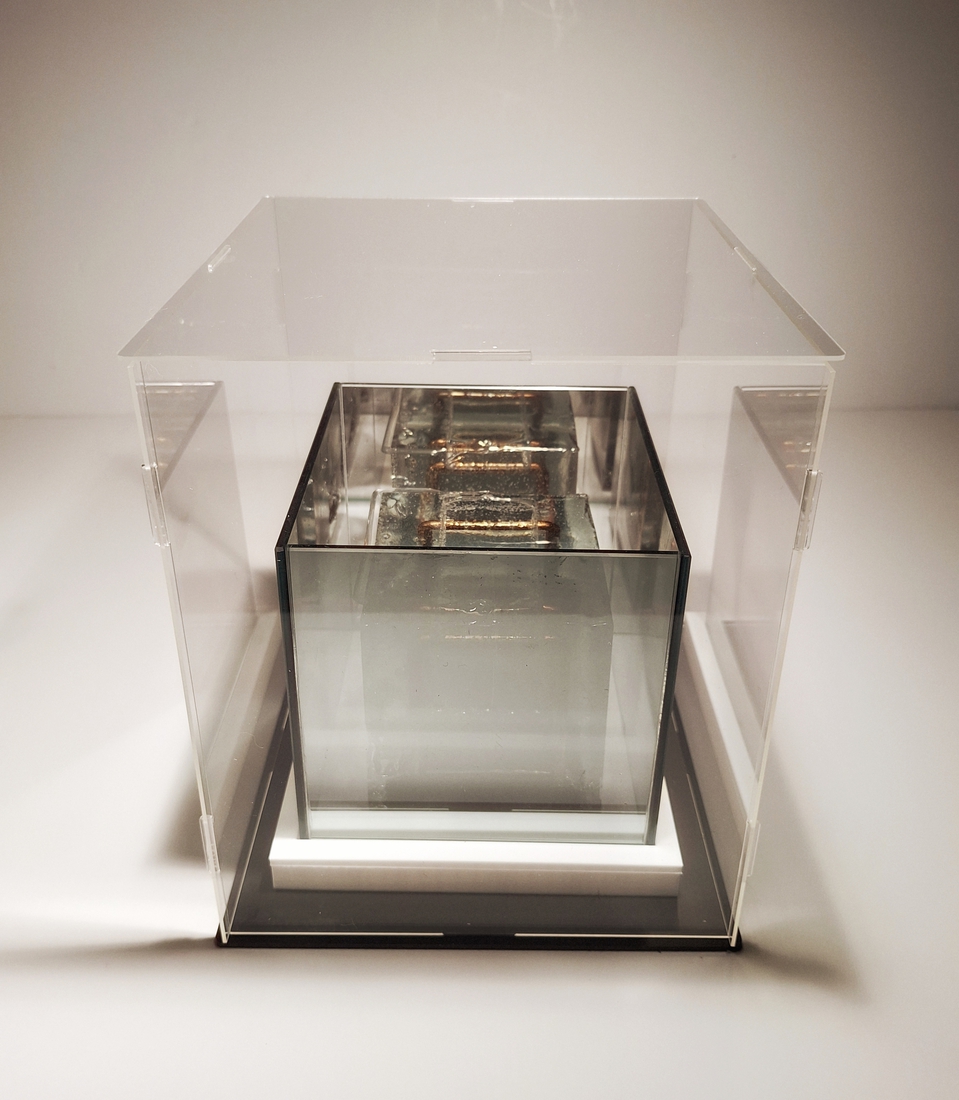
Pure Science centers on a cheap Newton’s cradle cast into a resin block. The casting introduced air bubbles, distortions, and chemical impurities, clouding the material and allowing the metal structure to oxidize. A device normally used to illustrate perfect causality and Newtonian determinism thus becomes partially unreadable and materially unstable.
The cube sits inside a second-hand mirrored structure that endlessly multiplies its image. This assembly is placed on a neutral white pedestal and enclosed in a plexiglass box. These successive layers create distancing frames that both separate the viewer from the object and elevate its authority.
The work draws on Thomas Kuhn’s view of scientific knowledge as shaped by paradigms that structure perception and interpretation. The resin’s defects act as visual analogues of Kuhnian anomalies—small irregularities that accumulate until a model loses its apparent clarity. Instead of staging a dramatic scientific revolution, the piece shows how a compromised model persists through reflection, preservation, and institutional display.
The pedestal turns the damaged object into an authorized exhibit. What appears as unstable or failed knowledge is stabilized through museological framing, suggesting that scientific truth emerges not only from experiment and theory but also from (sociological) practices of presentation, validation, and collective recognition.
Pure Science examines how systems of knowledge endure even as their material and conceptual foundations begin to erode.