Conceptual work
Video- and 3D installations, art als applied philosophy.
uit 2006 tot 2026
(klik op de afbeelding om het werk groter te bekijken)
stuur een bericht

The Supremacy of Signs
2026A second-hand belt is presented on a modest platform. Attached to its fastening pin is a transparent epoxy sphere filled with decorative elements that echo the sparkling stones embedded in the buckle. Although the addition appears to enhance the object aesthetically, it renders the belt unusable: the pin can no longer pass through the belt holes. Next to the belt, three larger epoxy spheres are displayed inside an oversized transparent display case. They contain the same material as the attached sphere but increase progressively in size. While these spheres have no practical function without the belt, they are presented as the most valuable elements of the installation. The work examines the shift from use value to sign value. In contemporary consumer culture, objects are increasingly valued less for their practical function than for the symbolic meanings they communicate. Accessories, ornaments and luxury markers no longer merely express an object's identity; they become its primary source of value. This inversion refers to Jean Baudrillard's analysis of the sign economy. Objects circulate not simply as useful things but as signs within a system of symbolic and social differentiation. Here, the belt is reduced to a support for its accessories, while the accessories—despite depending entirely on the original object—acquire the highest symbolic status. The display case does not merely protect what is valuable; it actively produces value. The Supremacy of Signs materializes a Baudrillardian inversion in which the sign eclipses the object and representation becomes more important than function.

Transient Visibility - Studies in Failed Resurrections
2026
Transient Visibility – Studies in Failed Resurrections is a video and sculptural installation exploring digital warfare, anonymity, and the fragile visibility of human existence.
The work originates from circulating FPV drone footage from the war in Ukraine. In these videos, soldiers are tracked and approached from the perspective of the drone itself. Through their massive circulation on social media, these death sequences gradually lose their gravity and become reduced to transient visual information within a continuous digital image stream.
The installation attempts to reverse this process. Through dual-screen projections, the footage is temporally deconstructed. Both screens show the same event, but their synchronization is deliberately displaced: the image of the targeted soldier begins later so that the final moments on both screens coincide. This temporal strategy redistributes attention away from the drone trajectory and toward the fleeting human presence that would otherwise disappear almost instantly within the original footage. By extending the visibility of the victim, the work shifts attention away from spectacle and toward vulnerability, from operational velocity toward contemplation.
Opposite the projection, a series of small 3D-printed figurines is placed on a white floating wall shelf. These figures are derived from frames extracted from drone footage, AI-enhanced reconstructions, and digital 3D conversions of the depicted soldiers. Printed in matte white PLA, they function as fragmentary relics or failed resurrections: material echoes of individuals who have already disappeared.
At the center of the work lies the idea of the “failed resurrection”: the attempt to temporarily restore human presence through digital reconstruction, while every reconstruction inevitably remains incomplete and artificial.

After the Game
2026After the Game is a small sculptural installation based on a simple plastic toy designed to launch and catch lightweight balls. In its original form, the object requires movement, coordination and repetition: an action unfolds through a sequence of attempts, successes and failures. In this work, that dynamic has disappeared. The mechanisms are rendered inoperative through subtle interventions. One ball is permanently sealed inside a transparent resin cube. In one device, the launching mechanism is blocked by hardened resin; in another, the opening of the catching basket is obstructed by a resin form containing a second ball. The system remains visible, but can no longer function. The elements are arranged without a clear operational logic, as if they were left behind after use. This absence of direction shifts the work away from demonstration and toward a condition of quiet suspension. The toy no longer performs; it persists. Presented on a minimal pedestal and enclosed within a transparant vitrine, the installation assumes the status of an artifact. The materials - plastic and resin - retain the visual language of play while withholding its activation, imbuing the work with a quiet sense of melancholia.

Air-to-Air (Terminal Pressure)
2026This work explores the unmasking of the utilitarian object. Inspired by Martin Heidegger’s phenomenology, a banal foot pump is stripped of its Zuhandenheit (readiness-to-hand). By irrevocably casting the valve into a sphere of transparent epoxy, the instrument's functional outlet is amputated. The pump, originally engineered for expansion and pressure, becomes a monument to obstruction. The title "Air-to-Air" serves as a techno-cynical commentary on the object's internal logic. The movement of air occurs, yet the destination has become the source; a hermetic short circuit. The object is no longer an extension of human will (a tool to inflate a tire), but returns to its essence as an autonomous Ding (Thing). Positioned on a 3D-printed pedestal, the mechanical frustration of non-functionality transforms into an aesthetic contemplation of the materiality of air and the violent silencing of labor.

Between
2026Between presents an apparently coherent system that is structurally unable to operate. At the bottom of a transparent epoxy block lies a metal drain strainer. Above it, a bathtub plug is partially cast into the same mass, positioned as if resting or floating, yet effectively immobilised. The chain runs over the edge of the block and terminates in a very small resin cube in which only the fastening ring is sealed. All components are present. Their alignment suggests proper function. Yet no transmission occurs. The mechanism is not destroyed but minimally interrupted, precisely at the point where transfer should take place. The obstruction is small, almost banal, yet decisive. Transparency plays a double role: it promises clarity and control while fixing the very distance that prevents operation. What is visible remains inaccessible. What logically belongs together remains materially separated. Between materialises a state of permanent potential without effect — a system that appears rational, yet in which the possibility of action is structurally suspended.

Conditioned Entry
2026
A black purse is presented upright on a minimal support. At first glance, it appears as a functional, everyday object. Only upon closer inspection does a subtle intervention become visible: the two spherical knobs of the clasp have been cast in resin, fixing the mechanism in a permanently closed state. The purse can no longer be opened.
The work targets the threshold of access. Rather than altering the object’s body, it intervenes precisely at the point where use is initiated. The condition of entry is preserved in form but neutralized in function. What remains is a system that signals accessibility while structurally preventing it.
This minimal gesture produces a shift in ontological status. The purse moves from a use-object to an object of display, from tool to sign. The transformation is not immediately apparent but unfolds through delayed recognition. The familiar becomes subtly inconsistent: an object that looks operable but is not.
The work operates within the logic of constraint, where access is not denied outright but conditioned in such a way that it can never occur.

Handle Without Care (Vorhandenheit)
2026The work consists of a vintage ironing tool whose handle has been cast in transparent epoxy resin. Through this intervention the object is physically disabled: the handle remains visible and appears graspable, yet it can no longer be held or used. The tool thereby loses its functional status and shifts from utilitarian object to contemplative artefact. The gesture refers to Martin Heidegger’s distinction between Zuhandenheit (ready-to-hand) and Vorhandenheit (present-at-hand). Originally absorbed in use and action, the iron is withdrawn from any practical relation. It no longer operates as an instrument but appears as a thing — isolated, visible, and unavailable. Placed on a 3D-printed pedestal and enclosed within a plexiglass vitrine, the object is institutionally reframed. The display reinforces its transformation from tool to artefact and emphasizes the passage from use to observation. The work examines how functionality, meaning, and truth shift once an object is removed from its context of action.

Nested Ambiguity
2026This installation presents a constellation of glass bottles whose arrangement visually suggests that they fit into one another. At first glance the structure appears to form a system of nested containers — an interior space containing another interior. On closer inspection, however, this hierarchy does not truly exist: the bottles are merely positioned next to and above one another rather than actually contained within each other. Within the bottle structure one cap is missing. This cap has been removed and cast separately in a small block of epoxy placed beside the arrangement. By isolating this element, a functional component of the system is rendered unusable. At the same time, the absence of the cap introduces uncertainty within the bottle structure itself: it remains unclear what the internal consequence is. Is the passage through the bottles now open? Or is only one of the three bottles open while the others remain closed? This ambiguity reinforces the central tension of the work. The installation engages with the human tendency to project order, causality, and structure onto what we perceive. What initially appears to be a clear example of “nested containment” ultimately reveals itself as a visual and conceptual misreading.

Pending (A Case for Imaginary Solutions)
2026A found object with no identifiable function is presented as a seemingly calibrated instrument. It is held in equilibrium on a 3D-printed base and support. Beneath its circular metal plate lies a thin, identical disc coated with paraffin. The diameter and alignment are exact, yet no physical contact occurs. The elevated petri dish introduces the impression of suspended containment. The configuration suggests a causal relation: as if the metal plate produced, registered, or affected the paraffin disc. At the same time, any actual interaction is excluded. The work constructs a pseudo-function and an indeterminate causality, inviting the viewer to assign meaning and operation to a system that ultimately refuses both. The object is not defined but activated as a carrier of expectation. The perceived relation between the two circles is convincing yet unverifiable; an effect without locatable cause.

Pre-empted Causality
2026Pre-empted causality investigates how objects generate meaning even before an action can actually occur. The installation consists of two parallel systems in which everyday objects — candles, matches, candle extinguishers, and residues of combustion — are removed from their ordinary functionality. Both candles and matches are encapsulated in resin, materially preventing any possibility of ignition. Yet the objects continue to refer to a chain of cause and effect: ignition, burning, extinction. The installation therefore creates a paradoxical condition in which all the prerequisites for an event appear to be present, while the event itself remains structurally impossible. The extinguishers hover above candles that can never burn; the matches are preserved prior to any possible use; traces of black ash suggest a combustion that could never have taken place within the system itself. A tension emerges between potential and impossibility, expectation and cancellation. The two configurations operate as two autonomous variations of the same underlying logic. Through their rotated spatial relation, the work establishes a field of displaced causalities in which the viewer continuously attempts to reconstruct relationships that ultimately remain closed. Much like David Hume argued that causality itself is never directly observable but arises through mental association, the installation reveals how meaning and expectation emerge through the mere presence of objects.

Pure Science
2026Pure Science centers on a cheap Newton’s cradle cast into a resin block. The casting introduced air bubbles, distortions, and chemical impurities, clouding the material and allowing the metal structure to oxidize. A device normally used to illustrate perfect causality and Newtonian determinism thus becomes partially unreadable and materially unstable. The cube sits inside a second-hand mirrored structure that endlessly multiplies its image. This assembly is placed on a neutral white pedestal and enclosed in a plexiglass box. These successive layers create distancing frames that both separate the viewer from the object and elevate its authority. The work draws on Thomas Kuhn’s view of scientific knowledge as shaped by paradigms that structure perception and interpretation. The resin’s defects act as visual analogues of Kuhnian anomalies—small irregularities that accumulate until a model loses its apparent clarity. Instead of staging a dramatic scientific revolution, the piece shows how a compromised model persists through reflection, preservation, and institutional display. The pedestal turns the damaged object into an authorized exhibit. What appears as unstable or failed knowledge is stabilized through museological framing, suggesting that scientific truth emerges not only from experiment and theory but also from (sociological) practices of presentation, validation, and collective recognition. Pure Science examines how systems of knowledge endure even as their material and conceptual foundations begin to erode.

Sedimentation of Cause
2026Sedimentation of Cause presents a standard office hole punch partially embedded in a transparent epoxy block. At the base, a dense layer of metallic confetti—the by-products of perforation—forms a compact, almost geological sediment. Notably, this confetti slightly deviates from what the instrument itself would produce: the discs are marginally smaller in diameter. The punch, designed to produce holes, is here arrested by the result of its own action. Cause and effect appear to coincide, yet this minimal discrepancy unsettles that assumption. The residue is plausible, but not fully congruent with its presumed origin. What would normally fall away as waste returns as mass and immobilizes the tool. At the same time, the subtle mismatch introduces uncertainty: does the object produce these remnants, or are they attributed to it? The action is implied, yet can no longer be completed. The work engages a sceptical account of causality, in which the link between cause and effect is not inherent but constructed through habit and expectation. By materially entangling effect and cause while slightly dislocating them, Sedimentation of Cause destabilizes the apparent clarity of instrumental logic. What remains is a suspended system in which production, accumulation, and attribution converge.

Soft Evidence
2026A domestic tool is immobilized: the handle of a cheese slicer is cast in epoxy and partially sunk into a wax-covered cube. The cube—3D printed and coated with paraffin mixed with human hair and oil paint—hovers between object and body, between food and residue. Its surface suggests fat, skin, and decay, yet remains structurally geometric, resisting full identification. The slicer implies an action—cutting, portioning, consumption—but that action is suspended. No slice is visible. No causal chain can be confirmed. The tool is present, yet functionally absent. The epoxy acts as both preservation and obstruction: a transparent barrier that fixes the object while preventing its use. Wax drips extend from the cube onto the plinth, collapsing the distinction between object and support. These flows suggest time, heat, and transformation, but without a clear origin. Did the cube melt? Did something external intervene? The work offers traces of an event without allowing its reconstruction. The piece operates in a space of false causality: it presents all the signs of an action while withholding its occurrence. In this sense, it aligns with a logic where effects appear to precede or exist without causes. The body—implied but never fully present—“remembers” through material residues, yet what it remembers cannot be verified.

Terminal Configuration
2026This sculpture is based on a mechanical puzzle similar to a Rubik’s Cube. The object is designed as a system of manipulation: by rotating its segments, the blocks can continuously generate new configurations. In this version, one of the protruding blocks has been permanently embedded in a transparent epoxy resin cube. This intervention completely blocks the mechanism. As a result, the puzzle loses its function; it can no longer be turned or solved. The cube is therefore locked into a final, frozen configuration. A transparent material — a medium usually associated with openness and visibility — paradoxically becomes the very agent of closure. The work transforms an object designed for active problem-solving into a static artifact. The game becomes sculpture, and the system shifts from a field of possibilities into a closed structure. The puzzle thus becomes a metaphor for knowledge and interpretation: what was once a dynamic space of combinations now appears as a fixed and irreversible state.

Terminal Offset (a priori)
2026A metal handle is sealed inside a transparent epoxy block and placed on a wooden wall support. At first glance, it appears to be simply mounted to the wall. On closer inspection, it sits a few millimeters away from it, slightly shifted and not quite aligned with its own mounting. We immediately recognize it as a handle and assume it can be used, that it is attached to something, and that it is properly fixed in place. These are not conscious thoughts, but habits in how we look. Through small adjustments—the shift, the slight rotation, the gap from the wall, the lack of screws and the encapsulation in resin—those expectations begin to slip. The handle remains familiar, but something no longer adds up: how it is fixed, what it does, and what supports it become uncertain. In that sense, the work relates to the thinking of Immanuel Kant, who argued that our perception of reality is only possible through certain a priori structures—such as space, time, and causality—that shape how things can appear to us. The work makes visible how we understand things without noticing it. What usually feels obvious is here slowed down and made less certain.

Terminal Phase
2026Terminal Phase consists of an aged petrol burner placed on a dark industrial plinth. Part of the burner’s pumping mechanism has been removed from the device and is partially submerged into a localized field of white wax on the surface of the plinth. The burner itself remains physically intact but has become functionally compromised. Attached to the burner is a small transparent resin bulb that appears as an anomalous extension or output of the apparatus. The removed mechanism slowly disappears into the wax, creating uncertainty about the material state of the system. It is unclear whether the component is sinking, melting, being absorbed, fossilized, or emerging. The work stages a transformation process without revealing its cause or temporal origin. The dark plinth no longer functions merely as support, but as an active material surface that appears to absorb and destabilize the mechanism. The localized wax field suggests a slow and irreversible process of phase transition occurring within the system itself. The sculpture explores themes of failed functionality, latent transformation, causality and material instability. Rather than illustrating an event, the work presents a condition in which industrial matter appears to lose ontological certainty.

Measuring Device (To measure is to know)
2026Measuring Device (To Measure Is to Know) consists of a subtly deformed geometric object coated in dark industrial Hammerite paint and fitted with multiple spirit levels. The object is presented on a minimal display support, creating the impression that it hovers in space. Spirit levels conventionally function as instruments of precision, orientation, and objective verification. In this work, however, they are attached to a form that resists stable measurement. The object possesses no privileged orientation, while its irregular geometry causes the different levels to suggest conflicting frames of reference. Although the sculpture resembles a functional measuring instrument, it ultimately fails to provide a coherent reading. The work occupies an ambiguous position between scientific apparatus, sculptural object, and fictional device. It can be understood as a pataphysical instrument operating according to unknown laws, but equally as a model of a world that exceeds the systems designed to comprehend it. By presenting measurement as both necessary and unreliable, Measuring Device (To Measure Is to Know) creates a condition of perceptual and epistemological uncertainty in which orientation, certainty, and knowledge remain permanently provisional.

Untitled (Manual Entropy)
2026Manual Entropy explores the intersection of industrial obsolescence and biological persistence. By grafting a preserved botanical "bloom" onto the handle of a discarded hand tool, the work subverts the original utility of the object. The file—a tool defined by friction, resistance, and the shaping of hard materials—has surrendered its function to oxidation. This state of decay (entropy) is not presented as an end, but as a transition. The resin sphere acts as a static reliquary, trapping nature in a state of permanent suspension atop a relic of human labor. In Untitled (Manual Entropy), the masculine grit of the industrial past is literally "overgrown" by the delicate, silent logic of the natural world. It is a study of what remains when the hand stops working and the environment begins to reclaim the artifact.

Vertical Assembly (After Venus)
2026This work consists of a vertical assembly of found and fabricated elements: a lollipop encapsulated in transparent resin, placed on a faux-silver shell-shaped napkin holder, resting on a thin pink resin plane, supported by a glass candleholder, and mounted on a minimal white 3D-printed base. The sculpture loosely references The Birth of Venus, but replaces mythological emergence with an artificial appearance. The shell, traditionally a symbol of origin and nature, appears here as a decorative and industrial object. The sea is reduced to a thin layer of pink resin. What emerges is not a goddess, but a preserved lollipop: desire held in suspension. The work does not communicate a fixed meaning, but stages a condition of suspended appearance. In this sense, it resonates with Jean Baudrillard’s notion of the precession of signs: signs that no longer refer to reality, but precede and replace it. The lollipop is no longer an object of consumption, but a sign of desire that is itself fixed and exhibited. Materials associated with consumption, decoration, and display are stacked into a fragile equilibrium. The white base does not function as a classical pedestal, but as a minimal support that intensifies the vertical tension. Due to its reduced scale, it almost disappears as a display element, shifting attention to the precariously stacked forms above. “Vertical Assembly (After Venus)” explores how images continue to circulate after their original meaning has dissolved. What remains is an assembly of forms, materials, and references—an appearance without origin, an echo of an image that once seemed self-evident.

Wrench, Disabled — Held in Equilibrium
2026A steel wrench is fixed horizontally and supported at a single oblique point. Both functional ends are encapsulated in transparent epoxy blocks, rendering the tool permanently inoperable while preserving its form. The object is held in a state of balance that appears stable yet contingent, as if dependent on a minimal and potentially arbitrary condition. The work stages a contradiction between use and suspension. The wrench, an instrument of torque and intervention, is deprived of its capacity to act. Its ends are archived rather than erased: function persists as a visible but inaccessible possibility. The support does not simply carry the object; it defines the precise condition under which it can exist at all. Equilibrium here is not a neutral state but a constraint. What is presented is a system in which access is implied but structurally denied, and where causality appears evident while remaining unverified.

Still Life (For Use)
2026Still Life (For Use) presents three identical glasses on a fake silver plate, accompanied by a simple water pitcher. The first glass lies untouched, fully ready for use. The second has its upper half cast in resin, rendering it entirely unusable. The third has its lower half cast: technically functional but awkward to handle. By partially immobilizing these objects, the work changes their ontological status. The untouched glass remains ready-to-hand (Zuhandenheit), a tool whose being is absorbed in use. The resin-coated glasses shift toward present-at-hand (Vorhandenheit), their materiality and being revealed precisely through obstruction. The contrast between ready, hindered, and awkwardly functional exposes the tension between potential and actual use, and how estrangement transforms ordinary objects into contemplative presences. The simple water pitcher points to intended use, emphasizing the gap between function and being, and inviting reflection on desire, habit, and our assumptions about the everyday.

Ort der Unschuld
2026Ort der Unschuld is a spatial installation with video that examines the pursuit of innocence and purity as a political, ideological, and aesthetic construct. Starting from a kitschy souvenir plate from Berchtesgaden — a site that functioned both as a tourist destination and as Adolf Hitler’s mountain retreat — the work traces how ideals of authenticity, nature, and moral renewal recur across different historical contexts. The installation connects Lebensreform ideology, Heidegger’s philosophy, Nazi imagery, and postwar mass tourism, revealing how the desire for purity often entails a rejection of modernity, plurality, and democratic complexity. In the video, vacation footage filmed by Eva Braun is juxtaposed with tourist home movies from the 1960s and 1970s, exposing striking similarities in gesture, atmosphere, and visual language. Rather than equating historical guilt, the work reveals how images of innocence function as moral anesthesia. Ort der Unschuld ultimately extends this logic to contemporary travel culture, where nature and tourism are marketed as sources of authenticity and moral escape. Innocence appears not as a state of being, but as a powerful narrative — one that continues to circulate between ideology, aesthetics, and consumption.

Not intended for use
2026This work presents a commercially produced lollipop encapsulated in epoxy resin, irreversibly suspending its intended function. The process arrests all chemical, sensory, and temporal transformations associated with consumption. Although the wooden stick protrudes from the resin and preserves the formal interface of use, handling and tasting are structurally impossible. The addition of a mirrored, kitsch display element introduces the visual language of retail and luxury presentation. The object is elevated, reflected, and multiplied, aligning it with mechanisms of commodification and display. At the same time, this logic collapses: the object is presented as consumable while being fundamentally unusable. In Heideggerian terms, the work stages a displacement from Zuhandenheit (readiness-to-hand) toward a paradoxical condition of excessive presentation. The lollipop is no longer ready-to-hand, nor simply present-at-hand, but continuously exhibited as an object of desire without access. Its being is revealed precisely through the suspension of use.

Training Apparatus
2026This work stages an act of ontological sabotage. A hand‑muscle training tool—normally defined by its Zuhandenheit, its readiness‑to‑hand—is immobilized in epoxy and placed inside a decorated glass vessel on a marble plinth. Once fixed in resin, the tool can no longer function; it shifts abruptly into Vorhandenheit, mere presence‑at‑hand. What was designed for repetitive self‑improvement becomes a frozen relic, stripped of agency yet elevated as if it were an object of devotion. The transparent pink epoxy layer, a synthetic intermediary, interrupts the hierarchy between marble and glass. This added stratum introduces a cosmetic, almost bodily ambiguity, intensifying the destabilization of the object’s original ontology. The work examines how everyday tools can be dislodged from their intended mode of being. By suspending effort inside a decorative frame, the piece exposes how easily purpose, value, and meaning can be reassigned—or sabotaged—through material intervention.

Closed Circuit
2026Closed Circuit presents a banal utilitarian object whose function has been permanently suspended. The bath plug and its attachment are cast in epoxy resin, rendering any practical operation impossible. What remains visible is the gesture of use: a chain that suggests handling, pulling, activation. Both ends of the system are immobilized. The apparent continuity offered by the chain conceals a closed loop in which action circulates without consequence. The work draws on Martin Heidegger’s distinction between Zuhandenheit (readiness-to-hand) and Vorhandenheit (presence-at-hand). An object that would normally withdraw into use is here forced into visibility precisely through the loss of its function. Stripped of its capacity to act, the object no longer operates within a world of practice, but appears as a thing isolated from its purpose. Rather than depicting obstruction, Closed Circuit stages the persistence of functional form after functionality has vanished. Agency survives only as appearance. The viewer is confronted with a system that still looks ready, while silently refusing all use.

Limited epiphany
2025Limited Epiphany combines a 3D-printed architectural fragment with a wall-mounted box containing a resin cast of a falling human figure (9/11). The staircase, doors, and platform suggest access, transition, and orientation, yet lead nowhere. The architectural logic is intact, but function is suspended. Strong directional lighting produces sharp shadows. These shadows are partially replaced by solid, 3D-printed black forms mounted directly on the wall. As a result, shadow becomes object, and illumination loses its explanatory role. Cause and effect are visually present, but no longer reliable. The boxed figure refers to an image widely embedded in collective visual memory, yet it is presented without narrative framing. It is neither illustrated nor dramatized, but treated as a sculptural residue within a closed system. While the title suggests spiritual ascent, echoing the symbolic structure of Jacob’s ladder, this expectation is undermined by the falling figure, rendering the work a cynical commentary on the human condition. The work addresses the limits of revelation in visual culture and the boundaries of understanding itself.

Promesse de bonheur
2025Promesse de bonheur is a sculptural composition consisting of a 3D-printed boat placed on a simulated water surface, resin blocks in blue tones, a resin cast containing artificial pubic hair, and a resin block embedding yellow plastic flowers. The elements are arranged in a balanced, geometric configuration that recalls the visual language of constructivist painting. All materials in the work are artificial, frozen, and inert. Water does not flow, the boat does not move, flowers do not wither, and desire is preserved rather than lived. The composition evokes summer as an image rather than an experience: a season reduced to signs, colors, and surfaces. Despite its formal clarity and apparent lightness, the work carries a subdued melancholy. It does not depict pleasure itself, but the memory of having once expected it. The title, borrowed from Stendhal, points toward happiness as anticipation, as projection into the future. Here, that promise has already passed. What remains is a residue: a still life of expectations absorbed by time. The inclusion of pubic hair introduces a subtle disturbance. Even intimacy is rendered artificial, archived and faintly perverse. The work thus reflects on how desire, memory, and happiness are increasingly experienced as simulations, carefully preserved yet emptied of risk and immediacy.

Meatlove
2025Meatlove examines how contemporary culture packages and immobilizes emotions, despite their intrinsic instability. The gold slogan echoes the language of luxury branding, but clashes with the slowly shifting organic core. The work presents love as something we attempt to freeze — in symbols, in objects, in rituals — even though it continuously transforms, decays, and slips beyond containment. The sculpture holds this tension in a play of gloss, irony, and quiet dissonance. Meatlove is a compact sculptural work that explores the boundary between affection, consumption, and the illusion of permanence. A heart-shaped mass of raw minced meat is suspended within a transparent resin block above a thin layer of vivid pink pigment. The sculpture rests on a white 3D-printed plinth bearing the phrase “Love Never Expires” in glossy gold lettering. While the object suggests preservation and timelessness, it contains a quiet contradiction: even within airtight resin, the meat undergoes a slow, internal process of decomposition. These subtle, long-term changes—barely visible yet inevitable—undermine the coded promise of “no expiry.” The work thus becomes a paradoxical object that simulates eternity while betraying its own fragile materiality.

Theologia Negativa
2025Theologia Negativa is a tripartite installation that stages absence not as lack, but as a structured condition of meaning. The work draws on the tradition of apophatic theology, in which the divine can only be approached through negation, while simultaneously engaging contemporary theories of simulacra, trace, causal inference and reproduction. The installation consists of three elements arranged horizontally. On the left, a 3D-printed white replica of a devotional frame appears entirely empty. It is a copy without an origin, a form awaiting meaning that never arrives. In the center, the original frame from which a crucifix has been removed still bears the visible imprint of what once occupied it. The object testifies to a prior presence that can no longer be accessed. On the right, a translucent resin block contains a 3D-printed copy of the removed crucifix, suspended and slightly offset. The cross survives only as an object severed from its function and context. Meaning does not return through replication, preservation, or trace. Instead, it disperses across copies, residues, and absences. By separating the sign, its imprint, and its reproduction, Theologia Negativa exposes how contemporary belief systems persist not through faith, but through repetition and inference.

Equity is not equality
2025Equity Is Not Equality uses the visual language of kitsch and erotica to poke fun at one of today’s most moralised social concepts. Two seemingly identical nipple pasties are preserved in a clear resin block, illuminated like museum specimens. At first sight, they form a playful, decorative pair—until the viewer notices that one tassel hangs slightly lower than the other. This subtle imbalance mimics the familiar infographic used in social justice debates, where children of different heights stand on boxes to illustrate the difference between equality and equity. By replacing the didactic cartoon with erotic, low-culture objects, the work exposes how serious political ideas are often reduced to simplified, almost cartoonish imagery. The polished display—frozen in resin, clinically lit—parodies the authoritative tone with which such concepts are presented in public discourse. Equity Is Not Equality questions whether our moral frameworks are genuinely understood, or merely consumed as ready-made, feel-good narratives. Through irony, it invites viewers to reflect on how ideology, activism, and aesthetics intertwine within contemporary culture.

Post hoc ergo propter hoc (ter)
2025Post Hoc Ergo Propter Hoc is a reflective installation on the human impulse to construct causality from coincidence. A dual-channel video loop shows two isolated events: on the left, a match suddenly ignites; on the right, a candle begins to burn moments later. The scale and brightness of both images are identical, yet they remain separated, suspended in their own visual fields. No flame ever touches the candle. There is only a temporal sequence — a mere juxtaposition in time. Still, the mind instinctively forges a causal link: the match must have lit the candle. Beneath the projection, a 3D-printed platform holds a match and a candle, cast in resin. Frozen in their material stillness, they cannot physically interact. Their petrified presence further destabilises the viewer’s expectation of cause and effect. By provoking and then undermining the assumption of causal necessity, the work echoes David Hume’s critique: that causation is not a property of the world, but a habit of the mind — an interpretative glue applied to successive perceptions. What appears as a chain of events may be nothing more than correlation, coincidence, or narrative desire. Post Hoc Ergo Propter Hoc invites us to reconsider the certainty with which we attribute meaning, agency, and explanation to the world. It challenges the foundation upon which much of our reasoning rests, exposing how fragile, constructed, and illusory the notion of causality can be.

The silent spectacle of the self
2025This work presents a transparent drinking glass fully embedded in a solid block of epoxy resin. Completely sealed and immobilised, the glass becomes inaccessible and stripped of all practical function. It can no longer hold liquid, serve a purpose, or mediate any human action. It stands as an object existing in isolation, withdrawn from the realm of use. In this state of preserved stillness and inaccessibility, the object touches upon what Immanuel Kant calls the Ding an sich: the thing as it exists independently of human perception, interpretation, or instrumentalisation. By removing all utility, the viewer is compelled to encounter the object not as a tool but as an autonomous entity with an unknowable inner reality. The resin acts as a paradoxical medium: it reveals while it conceals. The glass remains visible, yet radically out of reach. The work foregrounds the tension between what we believe we perceive and what actually presents itself — between phenomenon and thing-in-itself. The glass becomes a silent confrontation with our impulse to project meaning, purpose, or categorisation onto the world. Our cognition of the world is nothing more than a game of mirrors.

Outdoor Bred
2025Outdoor Bred consists of a small sculpture made from minced meat, shaped with a cookie cutter into the silhouette of a pig and permanently encapsulated within a clear resin block. The object rests on a patch of artificial grass, placed atop a tall, minimal white pedestal. At the bottom of the pedestal, printed in small and understated letters, appears the term outdoor bred. The installation stages a quiet tension between authenticity and simulation. The phrase “outdoor bred” — borrowed from agricultural marketing to imply more ethical, outdoor-based husbandry — contrasts sharply with the synthetic grass and the preserved, lifeless meat. The work gently destabilises the rhetoric of “naturalness” so frequently deployed in food branding and ethical consumption. By fixing the meat in resin, the piece grants an illusion of permanence to a fundamentally perishable substance. The disproportion between the monumentality of the pedestal and the fragile scale of the object creates a dissonance between significance and banality. Outdoor Bred becomes a critique of the ways in which terms, images, and materials construct the appearance of purity or ethics, even when the underlying reality remains unresolved.
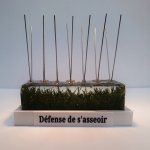
Défense de s'asseoir
2025A patch of artificial grass, inviting and familiar, is cast in resin and pierced by metal spikes. What promises comfort and accessibility is instantly withdrawn, transformed into a surface of exclusion. The inscription “Défense de s’asseoir” makes explicit what the object already declares. Normally, prohibition operates in a single register: either through text (law, language) or through material impediment (spikes, physical force). Here, both are imposed simultaneously, a double prohibition that renders the interdiction excessive and even absurd. The work refers to hostile architecture: urban strategies that prevent rest, gathering, or shelter, often targeting the most vulnerable. In this miniature, it becomes clear that control in public space is never neutral: hospitality is evoked only to be withdrawn, freedom promised only to be denied.
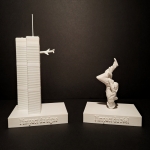
L'impact du signe
2025This 3D-printed installation questions whether the 9/11 attacks can still be seen as real events, or only as hyperreal images etched into collective memory. Inspired by Jean Baudrillard, it explores how the airplane and towers have become signs—icons in a media spectacle that transcends reality. The physical attachment of the plane to the tower emphasizes that it was not the object itself that struck, but its symbolic force. As Baudrillard wrote: “Reality itself has surpassed itself in its own simulacrum.” The installation reflects on how events are shaped, distorted, and fixed within image, media, and memory. The statue of the Falling Man adds a deeply human and existential dimension to the installation. The choice of the World Trade Center was not just strategic, but symbolic: a monument of Western economic power and globalization. The attack was a spectacle, aimed at disrupting the symbolic order. Its violence was designed to generate meaning—to create an iconic image that would flood the world. In this sense, the event took place primarily in the realm of representation, not material reality.

Physis
2025Physis, derived from phyō ("to grow"), in Pre-Socratic philosophy referred to an inner process of becoming and unfolding. Nature was not a static given but a dynamic force with its own drive for development. This contrasts with the modern scientific view, which sees nature as a mechanical system, explainable through laws and causality. The ancient concept of physis is revived in ecological thinking, where nature is not merely an object but a network of interactions and emergent processes. This installation confronts the viewer with the boundary between life and lifelessness, growth and stillness. By placing the coral on a platform and introducing minimal movement through an AI-generated video, the viewer is invited to reflect on how we understand and perceive nature. Here, physis is not conceived as a collection of objects but as a process—a continuous dynamic of formation, transformation, and transience. The installation encourages the viewer to break away from the modern scientific perspective, in which nature is primarily understood in terms of lifeless matter and fixed laws. By giving the coral a subtle, almost imperceptible motion, we are challenged to look and experience anew - to unlearn and unsee what we thought we understood.

Politique Indigène
2025Politique Indigène reconstructs Léon Rom’s notorious colonial residence and the yard where a gallows once stood, using 3D printing techniques. Rom, infamous for his brutality in the Congo Free State, decorated his home with skulls, becoming a symbol of the systemic oppression and atrocities of Belgian colonialism. The diorama's are presented together with a video that alternates between historical footage and AI-generated scenes, presenting an idealized, fictionalized version of colonization. The interactions between colonizers and locals appear peaceful yet remain deeply paternalistic and disruptive. The video reflects the politique indigène, a colonial policy that gave the illusion of autonomy for the indigenous population while maintaining control through coercion. It reveals how this policy concealed the oppression at the heart of Belgian colonialism. By blending historical footage with AI-generated content, Politique Indigène invites viewers to question how colonial history is remembered and presented. The work critiques how histories are reconstructed and how personal and geopolitical narratives shape our understanding of the past. It offers a critical visualization of the Belgian colonial project and encourages reflection on its enduring impact.

The ontology of truth 2
2025In The Ontology of Truth, the artist presents a white 3D printed cube embedded with six hyperrealistic nipples in three different skin tones. Each tone appears twice, always on opposing sides. Each nipple is also uniquely pierced. The cube is tilted on its pedestal, denying any neutral orientation and forcing the viewer into a specific perspective. The work playfully and ironically references Heidegger’s notion of aletheia — truth as both disclosure and concealment. At any given moment, only three sides of a cube can be seen; to reveal one aspect is necessarily to obscure another. The piece thus suggests that truth is not a fixed entity but a situation — a perspectival condition, contingent on location, position, and viewer. From every angle, three distinct skin tones are visible, but due to the unique piercings, no two perspectives are the same. The bodies in the work — vulnerable, intimate, adorned, particular — return truth to the tactile, the corporeal, the human. Each piercing, each contrast of color, forms a micro-narrative. Together, they underscore the idea that what we see is always only a fragment of what is.
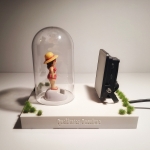
Qualitas Occultae
2025Qualitas Occultae is an interactive light-based installation that explores the invisible forces shaping our world, inspired by Newton’s concept of gravity and a childhood fascination with remote activation. The work features a small “flip-flap” figure under a glass dome, powered by a photovoltaic element. When the space is empty, the figure remains still. However, a motion sensor triggers a strong directional light as visitors enter, illuminating the dome and causing the figure to move, seemingly animated by an unseen force. This installation reflects on the mystery of action at a distance, a concept central to Newton’s understanding of nature but rejected by Leibniz, who dismissed it as an occult property. The piece also evokes the wonder of childhood discovery, like the marvel of solar panels and remote controls—technologies that enable objects to move without direct contact. By allowing viewers to witness a simple yet magical transformation, Action at a Distance seeks to reignite awe at the hidden forces governing our reality, much like Newton’s contemporaries once questioned how gravity could act across empty space. In an age where technology has made the extraordinary routine, this work encourages us to pause and rediscover the mysteries that quietly shape our world. Balancing scientific explanation with a sense of magic in natural phenomena, the installation invites us to reconnect with the marvel of the unseen.

All the things you cannot see
2024The video installation centers on an interview with a young woman discussing anxiety, disorientation, loss of control, and psychological splitting. She describes fears of being observed and judged. Using brief found footage segments, the installation visualizes her condition, reflecting universal fears and uncertainties. By juxtaposing visually analogous fragments, the work highlights the metaphorical nature of thought. Scientists appear as symbols of power in psychology, exposing the illusion of objectivity and its role in creating hierarchical, dehumanizing dynamics. The metaphor of fermentation prompts reflection on the limits of knowledge, the ontology of the unobservable, and how conceptual frameworks shape understanding and power structures. Next to the video stands a small figurine of the woman who plays the central role. Her portrait was scanned using AI, and the sculpture was realized in 3D-printed PLA, combined with wax. It is placed on a pedestal into which an LED light has been integrated.
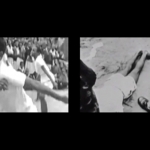
Tête-de-Nègre/White Innocence
2022The video installation consists of three sequences of images, based on found footage from Belgium's colonial history and American visual culture. The images make visible the binary, moral-theoretical oppositions that constitute Western thought (e.g., civilized-savage, uninhibited-disciplined, white-black, rational-emotional). In this way, the work seeks to reveal the associative fields and cultural archives (a term from Edward Said) that underpin the dominant Western self-image. The images construct a semi-imaginary history, a "theory-fiction" that indirectly and obliquely highlights certain aspects of historical and social reality. However, attempting to interpret the images literally, factually, or historically is futile. Above all, the work aims to evoke a sense of estrangement and alienation in the viewer, potentially prompting reflection on the racial ideologies and stereotypes that, often unconsciously, shape our thinking.
Post hoc ergo propter hoc (bis)
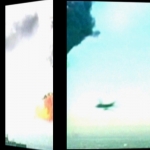
2013Double projection. The two images are projected onto a pillar-shaped structure, positioned at a 90-degree angle to each other. By temporally and spatially unraveling an iconic image—the WTC attack—the work questions the relationship between correlation and causality. As David Hume already observed, we perceive only the succession of events, not the causal connection itself.

Tussen hangen en vallen
2006Single channel video. 'Tussen hangen en vallen' is an old fishermen’s saying that refers to the moment just before sunset. This state of uncertainty serves as a metaphor for the condition humaine: for an existence in suspension.
Différance
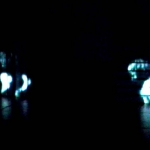
2006Double projections on random surfaces, intermittently synchronized, create moments of fleeting harmony. This interplay evokes Derrida’s différance, the continual shifting between sameness and difference through which meaning emerges. Simultaneously, it reflects Kierkegaard’s infinite interestedness—the existential striving to reconcile the finite and the infinite, the temporal and the eternal. In both cases, tension and oscillation are not problems to be solved but processes to be inhabited: the video enacts the rhythm of meaning and existence in flux, revealing harmony that arises only in the movement between opposites.
Post hoc ergo propter hoc
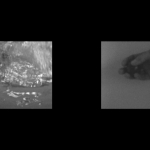
2006Double projection, in which a visual and mental association is evoked that questions the relationship between correlation and causation. By detaching the time dimension from, on the one hand, the hand releasing the ball and, on the other, the ball falling into the water, the mechanism of causal interpretation is called into question. It reveals that causality is, first and foremost, rooted in a mental reflex.