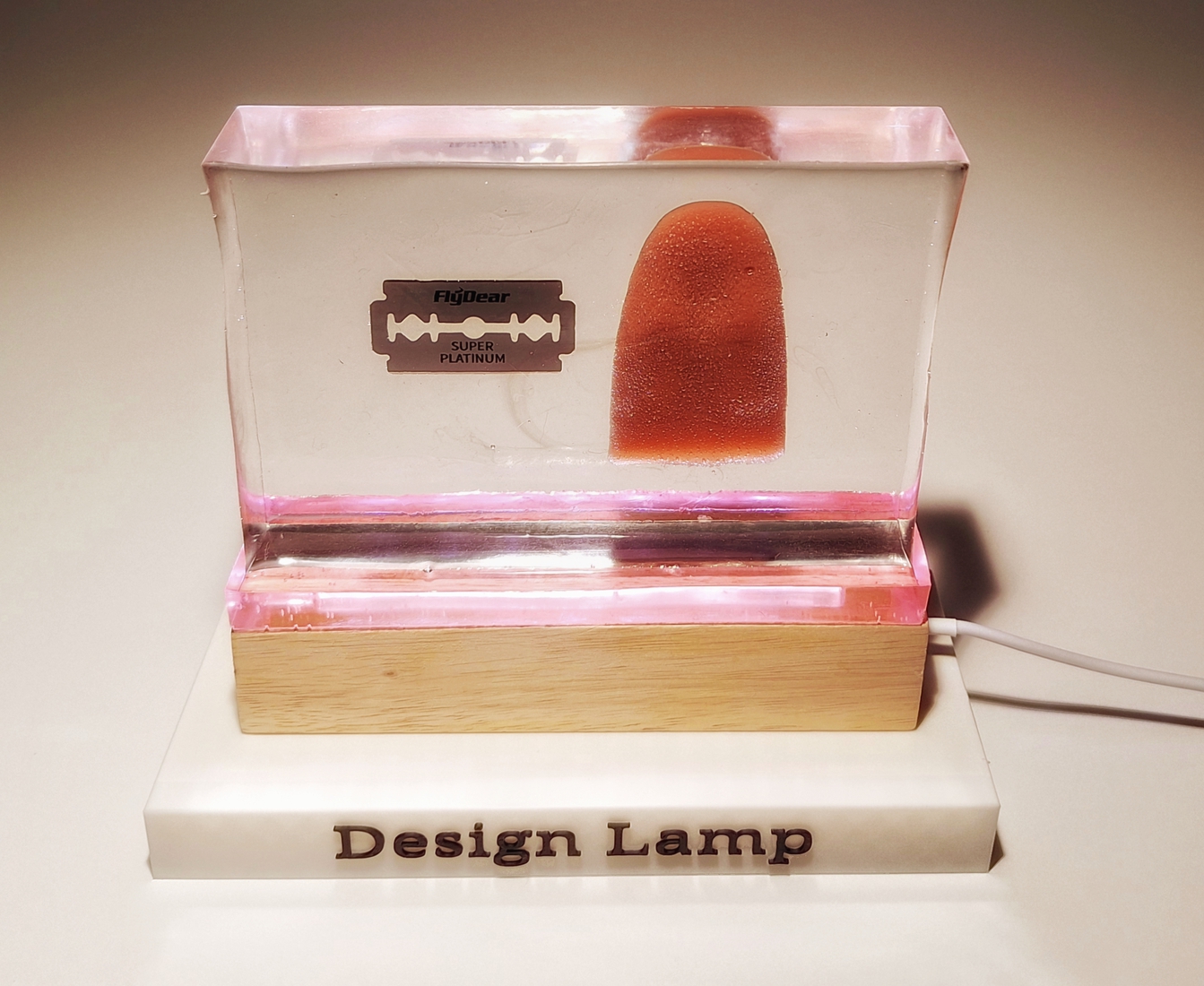
Design Lamp presents a tongue and a razor blade cast in transparent resin, mounted on a wooden base and illuminated with soft pink LED light. Formally, the object relies on familiar associations: tongue as language, razor as danger, resin as preservation, light as intimacy. This imagery is deliberately conventional and largely exhausted. As an autonomous artwork, it offers little resistance and risks collapsing into decorative design.
This weakness is intentional. The work becomes operative only through framing and title. By naming the object Design Lamp, its aesthetic emptiness is exposed. Like Duchamp’s Fountain, the object’s meaning does not derive from intrinsic qualities but demonstrates how art arises through conventions: naming, presentation, and institutional context. The transformation into art occurs only when these mechanisms are activated and made visible.
Design Lamp thus reflects on how contemporary art neutralizes its own critical potential through readability, polish, and seduction. Its failure is staged, revealing how art becomes harmless precisely at the moment it seeks relevance.